
Why Mentorship Matters in the Unfinished Stage of Leadership
Most leadership challenges are not clearly defined problems.
They are situations that feel slightly off. A project that is progressing, but without ease. A team dynamic that is functional, but unsettled. A decision that has been made, but is not producing the outcome you expected.
In these moments, leaders are asked to act quickly. To clarify, correct, or move forward.
What is less often acknowledged is that many of these situations are not yet ready to be resolved.
They are still forming. The problem is unnamed.
From inside the work, it is hard to tell the difference between something that is wrong and something that is simply not finished.
This is why mentorship is essential for effective leaders.
The Limits of Perspective in Leadership Roles
Leadership roles, particularly in the middle layers of an organization, require a constant shift between execution and interpretation.
You are close to the details. You are responsible for outcomes. You are expected to make decisions while information is still incomplete.
Over time, this proximity creates a constraint.
Research in cognitive psychology and organizational behavior shows that when individuals are deeply immersed in a problem, their attention narrows. They become more focused on immediate details and are less able to step back and evaluate the broader structure of the situation. This is not a failure of judgment. It is a function of being too close to the work.
In practice, this means that leaders are often making decisions from within a limited field of view.
They are not missing information. They are missing perspective.
Why Leaders Misinterpret the Unfinished Stage
Many leadership decisions are made at a point where the work has not yet fully taken shape.
There are partial signals. Early outcomes. Incomplete data. At this stage, it is common for things to feel disjointed or misaligned.
Without context, this is often interpreted as the problem that needs fixing.
Leaders may respond by increasing effort, accelerating timelines, or restructuring the plan entirely. In some cases, they may abandon a project prematurely for fear of building momentum in the wrong direction.
These responses are understandable. They are also often misaligned with what the situation requires.
Organizational research on sensemaking suggests that in complex environments, clarity emerges gradually. Early ambiguity is not necessarily a sign of failure. It can be a natural part of how systems evolve and integrate information.
How do you recognize when you are in the midst of that stage?
From the inside, the unfinished stage can look like something is wrong.
From the outside, it becomes clear that the work simply needs time, refinement, and perspective.
What Mentorship Makes Visible
The value of mentorship is not in providing answers.
It is in changing what you are able to see.
Mentors bring pattern recognition. They have encountered similar situations before. They can identify misalignment, proportion, and sequence in ways that are difficult to access when you are immersed in the work.
What feels unclear to you may be immediately visible to them.
This does not mean they are better at this. They have wisdom and they are not inside it.
That combination is a key contributor.
When a leader works in isolation, they are limited to their current vantage point. When they engage with a mentor, that vantage point expands. They are able to reassess what they are seeing without needing to step away entirely from their responsibilities.
Think of it as recalibration.
Calibration Is Often Refinement, Not Replacement
A common instinct in leadership is to reset when something feels off.
To step back. Rework the plan. Rebuild from the beginning.
There are situations where this is necessary. More often, it is not.
In most cases, what is required is refinement.
Small adjustments to how the work is shaped, how decisions are sequenced, or how priorities are weighted. These changes can be difficult to identify from within the work itself, because they require a different perspective about what is already in progress.
Mentorship supports this process.
Rather than discarding effort, it allows leaders to work with what already exists. To reshape, reframe, and adjust without losing momentum.
It requires patience, and a willingness to stay in discomfort while the work is still taking form.
The Discipline of Staying in the Unfinished Stage
There is a point in most meaningful work where it does not yet make sense.
The structure is incomplete. The outcomes are not visible. The signals are mixed.
This is the unfinished stage. I’ve heard it called the “messy middle.”
It is uncomfortable, and for many leaders, this triggers a need for action. The instinct is to resolve the discomfort quickly.
With mentorship, the experience changes.
The work may still be complex, but it is no longer confusing in the same way. There is a clearer sense of what is developing and what requires attention. The leader is able to stay engaged without rushing to resolution.
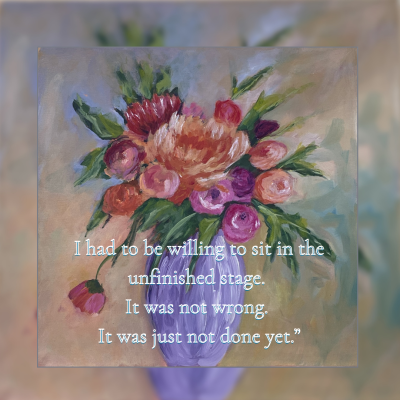
I spent a full day in a painting workshop, working on a simple composition. A vase of flowers in acrylic.
At the beginning of the day, I felt a surprising amount of anxiety. Not because of the time commitment, but because I did not know how to approach it. Composition is not something I have studied. Neither is drawing.
I could see what I was trying to create. I just did not know how to get there.
I picked up my chalk and started anyway.
By midday, the instructor came over to look at my work. She immediately saw what I could not.
The leaves were too large. The proportions were pulling the composition off balance. She showed me how to reshape them, not by erasing, but by working with negative space and painting the background back in.
Then she pointed to the main flower. The light values were reversed. What I had assumed was depth was actually flattening the image. She walked me through how to correct it, layer by layer.
There was a process to it. And more importantly, there was a need for patience. The painting, at that stage, looked incomplete because it was.
Not wrong. Just not finished.
That is what a good mentor does. They do not rescue you from the middle. They help you see what is already there, what needs to come next, and sometimes how to take that first step towards it.
Mentorship does not remove the unfinished stage. It makes it navigable.
Knowing When to Seek Mentorship
Not every situation requires external guidance. But there are consistent signals that suggest it may be useful.
- When the same issue continues to feel unresolved despite effort.
- When decisions are being revisited without meaningful progress.
- When something feels off, but you cannot clearly articulate why.
- When the instinct is to either push harder or start over entirely.
These are not signs of poor performance. They are signs of limited perspective.
Seeking mentorship is not a correction. It is a way of expanding how the situation is understood. Simply, a recalibration.
Perspective as a Leadership Capability
Leadership is often framed as the ability to act decisively.
Equally important is the ability to see clearly.
Clarity is not always a function of effort or analysis. It is often a function of perspective. Mentorship supports that perspective.
It allows leaders to move through complex, evolving situations with greater precision. It reduces the likelihood of overcorrection and helps maintain alignment as work develops.
In environments where decisions carry weight and consequences unfold over time, this capability is not optional for leaders.
It is foundational.
A Structured Pause
If you are in a moment where something feels unsettled or difficult to interpret, it may not require immediate action.
It may require a shift in how you are seeing the work.
Aligned by Choice is a mentorship opportunity designed to create that shift. It offers a structured pause to reflect on what you are holding, how you are approaching it, and where perspective may need to change before the next decision is made. If you’re interested in learning more, send me a DM and let’s chat.
Clarity does not always come from doing more.
Often, it comes from seeing what was not visible before.